
Relocation Guide
Moving to Saskatoon: A Local Relocation Guide for Buyers and Newcomers
A practical relocation guide to Saskatoon covering neighbourhood fit, transit, winter living, budgeting, and how to choose the right area for your actual daily routine.
Quick Answer
Saskatoon can be a strong relocation choice for buyers who want more space, a calmer daily rhythm, and a smaller-city feel with real services, but the right neighbourhood depends on your actual weekly routine, not just price. The city's CMA population was about 367,336 as of July 1, 2024, and the residential benchmark price hit a record $444,400 in May 2026. Most areas still favour driving, though Saskatoon Transit, OnDemand Transit, and the Link bus rapid transit project (under construction, service expected 2028) cover more ground than newcomers usually expect.

Planning a Move to Saskatoon?
Contact Tanner Washington for clear, local advice on choosing the right area for your budget, commute, and routine, no pressure.
Tanner Washington REALTOR®, Boyes Group Realty Inc. 639-295-4696 · tanner@tannerwashington.ca
Get in touchMoving to Saskatoon is not just about choosing a property. It is about choosing the version of daily life that fits you best. This guide is about fit, not just where to buy: will mornings feel manageable, will winter make the garage matter, will Broadway feel energizing, Stonebridge feel easier, or Warman feel peaceful but too far removed. Saskatoon is not one lifestyle, it is several lifestyles close together, and the goal here is to sort the decision into the pieces that matter most: your routine, budget, neighbourhood fit, property function, comfort level, and long-term flexibility.
How To Use This Guide
- Start With Your Week — Work, school, commute, activities, health care, groceries, and support network.
- Set The Real Budget — Purchase price, taxes, utilities, insurance, maintenance, condo fees, winter costs, and closing costs.
- Choose The Lifestyle Fit — Walkable and social, newer suburban, mature residential, or value focused.
- Shortlist Areas — Use routine, comfort level, property type, commute, and resale path to narrow the map.
- Compare Specific Properties — Condition, layout, garage, storage, basement, winter function, street feel, and future flexibility.
They Arrive for Affordability. They Stay for Breathing Room.
The Saskatoon CMA population was estimated at roughly 367,336 on July 1, 2024, making it Saskatchewan’s largest urban centre. Affordability is often the headline for buyers coming from Ontario, British Columbia, Alberta, or larger urban markets, but affordability alone does not explain why people stay.
- A detached home may still be realistic
- A garage may still fit the budget
- Family routines can feel less stretched
- Daily errands often feel more manageable
- Some investors may still find opportunities that are harder to underwrite in larger markets, but the numbers, location, property condition, and rental demand still need careful review
The bigger value is often time: less time commuting, less time parking, less time stretching every decision around housing costs. That is where Saskatoon starts to make real sense.
Is Saskatoon a Good Place to Live?
For many people, yes. But the better question is whether Saskatoon fits the life you are trying to build.
If You Want:
- More space
- A calmer daily rhythm
- A smaller city feel with real services
- Family routines that feel more manageable
- River trails, local businesses, university and hospital anchors
You May Need to Be Comfortable With:
- Major metro transit (Saskatoon’s network is still growing into that role, see Getting Around, below)
- Prairie winters
- Less dense nightlife
- Driving in many areas
- Different walkability by neighbourhood
- A city that is not Toronto, Vancouver, or Calgary at a discount
The best relocation decisions happen when people are clear about what they are moving toward, not just what they are trying to get away from.
The Different Ways Saskatoon Can Feel
Saskatoon is compact, but daily life can feel very different depending on where you live. Before you choose a neighbourhood, it helps to understand which version of Saskatoon you are most likely to enjoy living in: walkability and character, newer home function, mature residential stability, more budget flexibility, or future upside. Most buyers cannot maximize every category at once, so the goal is deciding which tradeoffs are worth making.
River, Character, And Walkability — Areas like Nutana, Buena Vista, City Park, and parts of Varsity View can appeal to buyers who want coffee shops, river trails, older homes, local businesses, and a more connected feel. This may frustrate you if you want a newer layout, attached garage, easier parking, or fewer older-home maintenance questions.
Newer Suburban Function — Areas like Brighton, Rosewood, Evergreen, Stonebridge, and Hampton Village often appeal to buyers who want newer layouts, garages, storage, parks, and family routines that feel easier to manage. This may frustrate you if you want mature trees, stronger walkability, or character homes.
Mature Residential Stability — Areas like Lakeview, Wildwood, Erindale, Arbor Creek, Lawson Heights, and River Heights can appeal to buyers who want established streets, parks, schools, trees, and a quieter residential feel. This may frustrate you if you want newer finishes or a more modern floor plan.
Value, Growth, And Street By Street Nuance — Areas like Mount Royal, Hudson Bay Park, Westview, Mayfair, Caswell Hill, and parts of the Confederation area may offer more budget flexibility, renovation upside, or investment potential, but street-by-street variation, comfort level, and renovation quality matter more here than elsewhere.
Understanding Saskatoon’s Layout
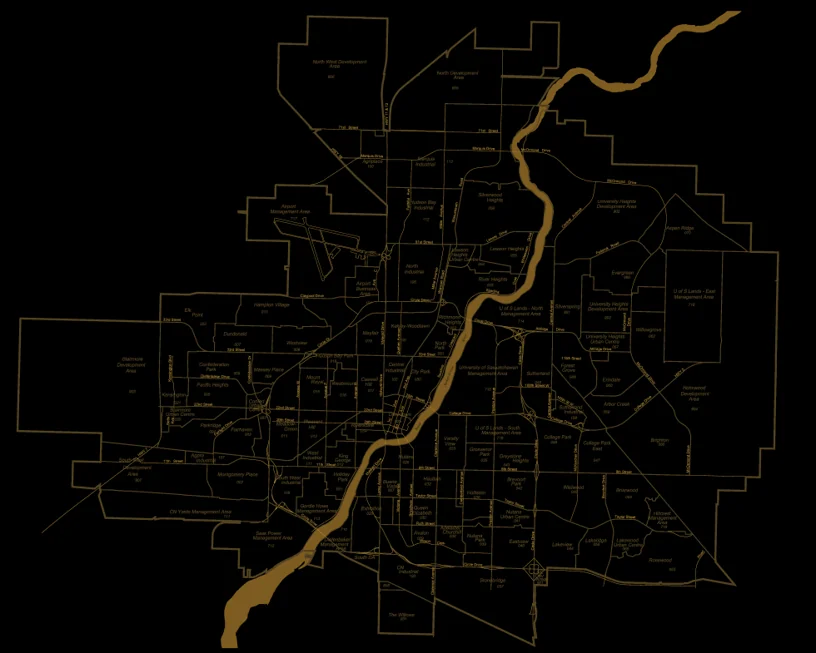
Saskatoon wraps around the South Saskatchewan River, and the river, bridges, and major routes shape how connected a neighbourhood actually feels.
Saskatoon is compact, but it does not function the same in every direction. The river, bridge crossings, Circle Drive, College Drive, 8th Street, Attridge Drive, the university, hospitals, airport corridors, north industrial areas, and newer growth edges can all change how convenient a home feels. Tanner can help you compare neighbourhoods based on your actual routes, not just distance on a map, including work access, school runs, bridge crossings, winter driving, and parking.
The River is Beautiful, but it Also Shapes Your Routine
The South Saskatchewan River gives Saskatoon much of its beauty, but it also affects how daily life works. A home can look close on a map and still feel less convenient if work, school, daycare, groceries, or activities keep pulling you across a bridge. Watch the repeating drives: bridge crossings, College Drive, 8th Street, Attridge, Circle Drive, school traffic, north industrial morning flow, and winter road conditions. A Saturday showing does not tell you how Tuesday morning will feel; before choosing an area, map your repeated drives for work, school, daycare, groceries, activities, family support, and health care.
Where You Work Should Influence Where You Live
A good relocation plan starts with where your life will happen, not just where the nicest listing appears.
University + Hospitals — University of Saskatchewan, Royal University Hospital, Jim Pattison Children’s Hospital, City Hospital, St. Paul’s, and Innovation Place often make central access, east central access, and route planning more important.
Trades + Industrial — North industrial, airport corridor, logistics, construction, and early morning shift work can point to very different areas than a downtown or university-based routine.
Remote Work — Quiet streets, natural light, office space, coffee nearby, and walking routes can matter more than commute time.
Start with your actual week, not the nicest listing. Map work, school, groceries, activities, winter driving, parking, and river crossings first, then focus on the Saskatoon areas that make that routine easier.
Getting Around: Transit, OnDemand, and the Coming Link BRT
Most Saskatoon residents still drive most places, and that is unlikely to change soon. But transit plays a bigger role than newcomers usually expect, especially near downtown, the university, and in a few newer neighbourhoods that are not on a fixed bus route at all. Knowing how the system actually works, and what’s about to change, helps you judge whether a neighbourhood’s “walkable” or “transit-connected” reputation holds up to your actual week.
Fixed Routes and Fares — Saskatoon Transit runs the city’s regular bus network. Effective July 1, 2026, adult fares are scheduled to be $3.50 for a single ride (up from $3.00), $27.50 for a 10-ride package, $9.50 for a day pass, and $91 for a 30-day pass, with the annual pass at $1,001. That is roughly a 10 percent increase on the day, monthly, and annual passes. Low-income and discounted social-service passes are expected to be held at their current rate, and children in Grade 8 and under continue to ride free. Confirm current fares directly with Saskatoon Transit before relying on these for budgeting, since rates are set by City Council and can change.
OnDemand Transit on the Edges — For newer areas without good fixed-route coverage, Saskatoon Transit runs an app- and phone-booked OnDemand service on a “stop-to-hub” model: book a ride to your nearest hub, then transfer to the regular network. As of this writing it serves Aspen Ridge and North Kensington directly, with connecting stops in Brighton, Rosewood, and Blairmore, Monday to Friday, 6 a.m. to 6 p.m., bookable up to two weeks ahead or on demand. If you’re considering a newer-suburb address, it’s worth checking whether it actually falls inside an OnDemand zone before assuming “no bus route nearby” means “no transit option.”
University Access and the U-Pass — Full-time students at the University of Saskatchewan, the Saskatchewan Indian Institute of Technologies, and other Saskatoon post-secondary programs get a U-Pass bundled into their tuition rather than buying transit separately, a discounted undergraduate rate of roughly $272 per semester, and a mandatory graduate-student rate of roughly $132 per term. That can shift the calculus between paying for parking near campus and renting or buying somewhere transit-connected instead.
What’s Changing: Link Bus Rapid Transit — Saskatoon is under construction on Link, a three-line bus rapid transit system: a Red Line from Blairmore through downtown and across the river to the University of Saskatchewan and Briarwood; a Green Line from Confederation through downtown to University Heights; and a Blue Line running Lawson Heights to Stonebridge. Combined, the three lines span about 38 km with 48 stations. Construction began in 2024, and service is expected to begin in 2028, so Link won’t change anyone’s commute this year, but it’s a real factor for buyers planning to stay five-plus years. Lawson Heights, Stonebridge, Briarwood, and University Heights each sit on a different planned Link line, while many other neighbourhoods do not.
A bus route on a map is not the same as a bus that actually runs every ten minutes at rush hour. Before assuming an area is “transit friendly,” ask about real frequency and reliability on the specific route you’d use, not just whether a route exists.
Sources: Saskatoon Transit, Fares & Passes and OnDemand Transit (saskatoontransit.ca), fare schedule effective July 1, 2026; University of Saskatchewan, Parking and Transportation Services, U-Pass program; City of Saskatoon, Link — Project Background.
Newcomer Logistics
Some of the most important parts of a move are the ones nobody puts on a wish list: health coverage, your driver’s licence, and getting your vehicle plated and insured. None of these are difficult in Saskatchewan, but they each run on their own clock, and the clocks start when you arrive. Sorting them early keeps a small administrative task from turning into a gap in coverage at the wrong moment.
Health Card Coverage — Saskatchewan Health coverage does not begin the day you unpack. Under eHealth Saskatchewan’s eligibility rules, coverage generally starts on the first day of the third month after you establish residency in the province. The intent is that your previous home province or country’s coverage normally bridges that waiting period, so you are not left without health care in the meantime. Some newcomers may qualify earlier depending on their situation. Register as soon as you arrive rather than waiting, and keep your former coverage active until Saskatchewan’s takes effect. Confirm the current rules and timing directly with eHealth Saskatchewan, since these details can change.
Your Driver’s Licence — New residents have 90 days to exchange an out-of-province or out-of-country driver’s licence for a Saskatchewan one. If you are coming from elsewhere in Canada, the exchange is generally straightforward without retesting. SGI also recognizes a specific list of countries whose licences exchange without retesting; licences from other countries usually require testing. Because that country list and the testing requirements change over time, check your specific case with SGI before assuming you will or will not need to retest.
Registering and Insuring a Vehicle — If you bring a vehicle into the province, you have 90 days to register and plate it in Saskatchewan, and basic insurance is required. Saskatchewan’s basic plate insurance runs through SGI, so registration and the mandatory basic coverage are handled together. Budget the time for this in your first weeks, not your first frantic afternoon, and confirm current requirements with SGI.
Importing a Vehicle From Outside Canada — Bringing a vehicle in from another country is a different process entirely. It is governed federally, through Transport Canada and the Registrar of Imported Vehicles (RIV), rather than by SGI, and the rules around eligibility, inspection, and fees are set at that level. If this applies to you, treat it as its own separate task and verify the current federal requirements directly; this guide does not cover the specific fees, timelines, or eligibility for that route.
Settlement Support
You do not have to figure all of this out alone. Saskatoon has settlement organizations whose entire purpose is helping newcomers land, covering things like paperwork, language support, employment, schools, and day-to-day orientation.
- Saskatoon Open Door Society (sods.sk.ca) is a long-running Saskatoon settlement organization that supports immigrants and refugees with settlement services, language training, and employment help.
- The Government of Saskatchewan’s “Find immigration services near you” directory lists funded settlement service providers across the province, so you can find the option closest to where you are landing.
If you are relocating from outside Canada, it is worth contacting a settlement organization before you arrive, not after. Tanner can focus on the home and neighbourhood side of your move while these organizations handle the newcomer services, and the two fit together well.
Winter Reality
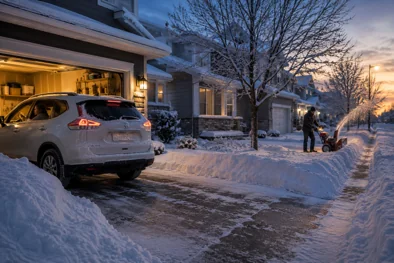
In a prairie winter, an attached garage, a cleared driveway, and a functional entry stop being luxuries and start being part of the daily routine.
Winter does not make Saskatoon unlivable. It makes property function more important. In January, an attached garage does not feel like a luxury, it feels like part of your morning routine.
Winter Function to Review:
- Mudrooms and entries matter
- Garage and parking matter
- Storage becomes more valuable
- Windows, furnaces, insulation, and air sealing matter
- Driveway drift, snow clearing, and street maintenance become part of daily life
- Basement moisture, grading, and drainage
People adapt well when they build winter into the decision instead of treating it like a footnote.
Choosing a Saskatoon Neighbourhood as a Family
For families, the “best” neighbourhood is not always the one with the most familiar name. It is the one that makes your actual week easier.
School Routine — School fit is more than distance on a map. Look at catchment areas, program options, daycare availability, before and after school care, activity schedules, and how the morning drive actually works.
Home Function — The right family home needs to handle real life: bedrooms, storage, parking, mudroom space, yard size, basement layout, garage use, and winter gear.
Daily Convenience — Family friendly also means groceries, medical access, playgrounds, sports facilities, transit options, commute patterns, and having support nearby when life gets busy.
Long Term Fit — Kids age, school needs shift, commutes change, activities move, and resale matters. The right area should fit your current stage of life while still making sense later.
For a closer look at specific Saskatoon neighbourhoods, school access, housing styles, amenities, and buyer fit, see the neighbourhood guides on this site.
Newer Suburb or Mature Neighbourhood?
Both newer suburbs and mature neighbourhoods can be the right choice, but they usually solve different problems.
Newer May Fit if You Value: Attached garage, modern layout, storage, newer mechanical systems, and family routines built around school, parks, errands, and home.
Mature May Fit if You Value: Trees and character, central access, walkability potential, established streets, larger lots, and a sense of place that already feels rooted.
Newer is not automatically better, and mature is not automatically harder. The right choice is the one that fits your routine, your budget, and the way you actually want to live.
Does This Specific Street and Routine Fit My Comfort Level?
Relocation buyers are rarely just asking about statistics. They are asking whether they would feel comfortable coming home at night, letting kids play outside, or settling there after the excitement of the move wears off.
Street Feel — Neighbourhood reputation can be useful, but it is often too broad. Some Saskatoon areas change noticeably from one pocket to the next.
Property and Neighbouring Homes — Exterior care, yards, fences, parking patterns, renovation quality, and nearby property condition can influence comfort and resale perception.
Surrounding Uses — Busy roads, commercial uses, schools, parks, vacant lots, alleys, and traffic patterns can all change how a location feels day to day.
Data and Due Diligence — Public police data, school information, municipal maps, repeat visits, and local context should be treated as pieces of the decision, not the whole answer.
Health Care Workers, Students, Singles and Professionals
Health Care Workers — Hospital access, shift times, parking, winter routes, and commute reliability often matter more than distance alone.
Students — Campus access, transit, rent, roommates, parking, and simple daily logistics usually matter most (see Getting Around, above, for U-Pass details).
Young Single People — Restaurants, coffee, gyms, river trails, downtown access, nightlife, commute, and social circles may matter more than yard size.
Professionals — The right fit often depends on commute, parking, quiet space, home office needs, and whether the buyer wants a connected area or a quieter place to recharge.
These groups can overlap, but they do not always value the same locations. Similar budgets can still point to very different areas.
The Question is Not Only “Is It Cheaper?”
Most people do not move to Saskatoon just because they want a cheaper house. They move because they hope their money creates a better life: more space, less pressure, a garage, a yard, and a shorter daily routine.
Budget Beyond the Purchase Price — Taxes, utilities, condo fees, heating, maintenance, insurance, driving costs, and repairs can change the real monthly picture.
Closing Cost Awareness — Saskatchewan does not have a traditional land transfer tax like some provinces, but buyers should still budget for legal fees, inspection costs, title and mortgage registration, property tax adjustments, insurance, moving expenses, utility setup, and PST on mortgage default insurance where applicable.
Budget Categories to Verify:
- As a planning estimate, many buyers use roughly 1 to 2 percent of the purchase price for closing and setup costs, separate from the down payment. The actual number depends on the property, financing, legal costs, inspections, adjustments, and insurance.
- Inspections: confirm based on property type and scope
- Property tax: use the actual annual amount, then divide by 12
- Utilities: ask for past bills where available
- Maintenance reserve: plan for repairs, winter upkeep, and future replacements
What Different Budgets Can Buy
Saskatoon’s residential benchmark price hit a record $444,400 in May 2026, up from $433,200 in April and $435,200 in March, the third straight month of record prices, driven by persistently tight supply.
Less than $300K — Often where buyers make the most tradeoffs: condos, townhomes, older detached homes, or properties that need updating.
$300K to $450K — Often a mix of condos, townhomes, semi-detached homes, and older detached options depending on condition and location.
$450K to $600K — Often where detached homes, garages, family-oriented areas, and more functional layouts start to feel more realistic, depending on inventory and condition.
$600K to $800K — May open up stronger detached options, larger homes, premium renovations, better garage setups, or more desirable mature neighbourhood locations.
$800K And Up — Stronger detached options, larger homes, premium renovations, and more desirable mature neighbourhood locations.
Use these ranges as orientation, not fixed rules. Saskatoon price bands shift with inventory, rates, property type, and market conditions, and as the May 2026 record shows, they can move noticeably from one month to the next.
Even Buyers Planning to Live in the Home Benefit from an Investor Lens
Even if you are buying the home to live in, it helps to think about future flexibility. A strong property should fit your life today and still make sense to future buyers, tenants, or resale demand later.
Legal Suites + Suited Homes — Can support affordability or rental flexibility, but zoning, permits, parking, layout, financing, and rental demand matter.
University Proximity — Can support rental demand, but purchase price and long-term resale still need to make sense.
Condos — May look affordable, but documents, reserve fund, insurance, fees, bylaws, and resale history matter.
Value Pockets — Some areas offer better numbers, but street, tenant profile, comfort level, and long-term trajectory matter.
Warman and Martensville Can Work Well, If Chosen Intentionally
Warman — Warman often appeals to buyers who want a smaller city feel, newer housing options, and some separation from Saskatoon. The fit depends on how often work, school, shopping, health care, kids’ activities, and social life still pull you back into the city.
Martensville — Martensville can appeal to buyers who want a smaller community feel while staying close to Saskatoon. It works best when the added driving still fits work, winter routines, kids’ activities, and weekend life.
Before choosing outside Saskatoon, ask yourself:
- How often will work pull me back into the city?
- Will winter driving change the commute?
- Are school, daycare, sports, and health care still convenient?
- Will weekend plans still happen mostly in Saskatoon?
- Am I choosing the community because it fits my life, or only because the house looks better online?
The right question is not whether Warman or Martensville is better than Saskatoon. It is whether the quieter pace is worth the extra driving for the life you actually live.
Saskatoon vs Regina and Calgary
Saskatoon vs Regina — Saskatoon often feels more river-oriented, university-influenced, lifestyle-driven, and visually layered. Regina often has a more government and administration-influenced rhythm, with a different employment and lifestyle pattern.
Saskatoon vs Calgary — Calgary offers more scale, major corporate employers, mountain access, a larger airport, and big city amenities. Saskatoon often offers easier daily routines, less congestion, and more manageable living.
Want scale, corporate opportunity, a larger airport, and mountain access? Calgary may fit. Want government and administration centered employment? Regina may fit. Want river lifestyle, university and hospital anchors, a local feel, and a more manageable daily routine? Saskatoon wins. The better question is not which city is “better,” but which city gives you the life you actually want next.
Renting First as a Bridge
You do not have to buy the moment you arrive. For a lot of relocators, renting for a few months first is the calmer path, especially if you are moving from far away and have not had time to learn how the city actually fits you.
Renting first buys you something the best listing photos cannot: lived experience. You get to feel a real Tuesday commute, sit through a stretch of actual Saskatoon winter, see which side of the river your week keeps pulling you toward, and learn which neighbourhoods match the life you are building rather than the one you imagined from another province. By the time you do buy, you are choosing from knowledge instead of guesswork, and that tends to make for a more confident, less reactive decision.
It is not the right move for everyone. If you already know the city, have a firm work location, and are confident about the area you want, buying directly can make more sense than paying to rent in the meantime. But if any of those pieces are still uncertain, a short rental can be the bridge that turns a rushed purchase into a deliberate one. Tanner can help you think through whether renting first or buying directly fits your timeline and your situation, and stay in touch through the rental period so you are ready when the right home appears.
A Local Plan Makes the Move Feel Easier
Relocating is easier when you are not trying to understand Saskatoon one listing at a time.
Step 1: Clarify the Must-Haves — Budget, timeline, work location, family needs, school considerations, parking, home type, and lifestyle priorities.
Step 2: Narrow the Map — Compare areas based on commute, river crossings, transit access, winter routes, amenities, comfort level, and property style.
Step 3: Walk the Shortlist In Person — Visit your top areas at different times of day, including a weekday morning or evening if you can. A neighbourhood that looks right on a Saturday showing can feel different on the Tuesday commute it would actually need to support.
Step 4: Review the Property Carefully — Condition, layout, heating, windows, roof, foundation, sewer, garage, storage, condo documents, rental flexibility, and resale path.
Step 5: Make a Clear Decision — Not because the house looks good online, but because the home, area, budget, and routine make sense together.
A stronger relocation plan makes the search less reactive and the final decision easier to trust.
Common Relocation Mistakes
Most relocation mistakes do not happen because buyers choose a bad home. They happen because the home is chosen before the routine, location, winter function, and long-term fit are fully understood.
- Choosing a Bigger Home That Adds Daily Friction — A bigger house farther away can look like a win online, then slowly wear on the week.
- Underestimating Winter Function — Garage, entry, storage, windows, furnace, parking, and snow clearing matter.
- Assuming Newer Always Means Better — Mature areas often offer location and character that newer areas don’t.
- Ignoring Older Home Due Diligence — Sewer lines, foundation, grading, insulation, windows, roof, and renovation quality need review.
- Trusting the Map More than the Feeling — Maps show distance. They do not show comfort, rhythm, or street feel.
- Overestimating Transit Coverage — A neighbourhood near a bus route is not the same as one with frequent, reliable service, and Link’s three lines won’t be running until 2028.
- Trying to Maximize Everything at Once — Most moves involve tradeoffs. The mistake is not compromising, it’s compromising on the wrong thing.
Relocation regret usually comes from choosing the house before understanding the life around it.
Moving to Saskatoon Checklist
Work + Commute
- Where will I work?
- Will I cross the river often?
- Do I need downtown, university, hospitals, airport, or north industrial access?
- Will winter driving affect my routine?
- Is my route covered by a fixed bus route, OnDemand Transit, or neither?
Schools + Family
- Have I verified school boundaries directly with the school division?
- Public, Catholic, French Immersion, or specific program?
- Are activities close enough?
- Does the home have enough storage, parking, and winter function?
Costs + Home Function
- Have I budgeted beyond the purchase price?
- Do I understand utilities and winter costs?
- Have I reviewed roof, furnace, windows, foundation, and sewer where relevant?
- Have I confirmed condo fees, reserve fund, insurance, bylaws, meeting minutes, and condo documents if buying a condo?
Lifestyle Fit
- Walkability or vehicle convenience?
- Newer construction or mature character?
- Saskatoon, Warman, or Martensville?
- Would this location still feel right after six months?
Local Guidance
- Have I narrowed the areas based on my actual week?
- Do I understand the tradeoffs between my top neighbourhoods?
- Have I reviewed the specific street, not just the neighbourhood name?
Score the Fit Before You Rank the Neighbourhood
Before choosing an area, rate how well it supports your actual week. A home can look right online and still be wrong if the routine around it does not work.
Rate each category from 1 to 5: 1 = poor fit, 3 = workable, 5 = strong fit
| Category | What It Covers |
|---|---|
| Work + Commute | Drive time, river crossings, winter routes, parking, shift times, and access to major roads. |
| Schools + Family Routine | School boundaries, daycare, activities, parks, storage, and whether mornings feel manageable. |
| Lifestyle Fit | Walkability, quiet, restaurants, river trails, groceries, recreation, and how the area feels after work. |
| Winter Function | Garage, driveway, entry, mudroom, windows, furnace, insulation, snow storage, street clearing. |
| Transit + Connectivity | Fixed-route or OnDemand coverage today, and whether a future Link line matters to you. |
| Resale + Flexibility | Future buyer appeal, rental potential, area perception, condition, and whether the home has more than one exit path. |
| Property Condition | Roof, windows, furnace, foundation, sewer, grading, renovations, and maintenance history. |
| Home Function | Layout, storage, parking, yard, office space, maintenance level, and whether the home fits daily life. |
Do not choose the neighbourhood first. Choose the routine first, then find the neighbourhoods that support it.
Frequently Asked Questions
Is Saskatoon a good place to relocate to? For many people, yes, but the better question is whether Saskatoon fits the life you are trying to build. It tends to suit people who want more space, a calmer daily rhythm, and a smaller-city feel with real services, and who are comfortable with prairie winters, a transit network still growing into a major-metro role, and a city that is not Toronto, Vancouver, or Calgary at a discount.
What is the average home price in Saskatoon? Saskatoon’s residential benchmark price hit a record $444,400 in May 2026, up from $433,200 in April and $435,200 in March, the third straight month of record prices. Price bands shift with inventory, rates, and property type, so use any range as orientation rather than a fixed rule and review current comparable sales before making decisions.
Does Saskatoon have public transit? Yes. Saskatoon Transit runs the city’s fixed-route bus network, plus an OnDemand Transit service for newer areas without good fixed-route coverage. The city is also under construction on Link, a three-line bus rapid transit system expected to begin service in 2028. A bus route existing on a map is not the same as frequent, reliable service, so confirm actual frequency for the specific route you’d use.
Should I consider Warman or Martensville instead of Saskatoon? Both can work well if chosen intentionally. The right question is not whether Warman or Martensville is better than Saskatoon, but whether the quieter pace and added driving still fit your work, school, health care, and weekend life.
How does Saskatoon compare to Regina or Calgary? Saskatoon tends to feel more river-oriented, university-influenced, and lifestyle-driven. Regina has a more government and administration-influenced employment pattern, and Calgary offers more scale, corporate employers, and mountain access, generally at a higher cost of living and with more congestion.
What should I budget for besides the purchase price? Taxes, utilities, condo fees, heating, maintenance, insurance, and closing costs, including legal fees, inspections, title and mortgage registration, property tax adjustments, and moving and utility setup costs. As a planning estimate, many buyers use roughly 1 to 2 percent of the purchase price for closing and setup costs, separate from the down payment, though the actual number depends on the specific property and financing.
When does my Saskatchewan health card coverage start after I move? Under eHealth Saskatchewan’s eligibility rules, coverage generally begins on the first day of the third month after you establish residency in the province, and your previous home province or country’s coverage normally bridges that waiting period. Some newcomers may qualify earlier depending on their situation. Register as soon as you arrive and keep your former coverage active until Saskatchewan’s takes effect, and confirm the current rules directly with eHealth Saskatchewan.
How long do I have to switch my driver’s licence and register my vehicle in Saskatchewan? New residents have 90 days to exchange an out-of-province or out-of-country driver’s licence and 90 days to register and plate a vehicle brought into the province, where basic insurance is required through SGI. Canadian licences and a specific list of countries exchange without retesting, while others may require testing, so confirm your specific case with SGI. Importing a vehicle from outside Canada is a separate, federally governed process through Transport Canada and the Registrar of Imported Vehicles.
Source Notes and Factual Anchors
This guide is written as a relocation planning resource, not a guarantee of current pricing, fares, or program details. Always confirm time-sensitive figures directly with the listed source before relying on them.
- City of Saskatoon, Saskatoon Strategic Trends 2025, CMA population estimate, July 1, 2024.
- Saskatchewan REALTORS® Association, Market Watch, March, April, and May 2026, Saskatoon benchmark price references, confirmed against CREA Statistics.
- Saskatoon Transit, Fares & Passes and OnDemand Transit pages, fare schedule effective July 1, 2026.
- University of Saskatchewan, Parking and Transportation Services, U-Pass program (undergraduate and graduate rates).
- City of Saskatoon, Link — Project Background (three lines, 38 km, 48 stations, construction begun 2024, service expected 2028).
- Saskatoon Public Schools and Greater Saskatoon Catholic Schools, school maps, attendance areas, and placement information.
- eHealth Saskatchewan, Eligibility for Health Benefits, health card waiting period and residency rules.
- SGI, Saskatchewan Driver’s Licence Program, licence exchange windows and out-of-country recognition list.
- SGI, Vehicle Registration, registration window and basic insurance requirement.
- Saskatoon Open Door Society and the Government of Saskatchewan immigration settlement services directory, newcomer settlement support.
- Environment and Climate Change Canada, climate normals for winter context.
Time-sensitive figures, including transit fares, the Link service timeline, SGI’s licence and registration windows and country exchange list, and eHealth Saskatchewan’s residency and eligibility rules, are set by the relevant authority and can change. Confirm them directly with the source before relying on them. The federal vehicle-import process through Transport Canada and the Registrar of Imported Vehicles (RIV) is referenced here only in general terms; verify the specific eligibility, inspection, fees, and timelines against Transport Canada or RIV directly.
Sources
- Saskatoon Transit: Fares & Passes and OnDemand Transit
- CREA Statistics: Saskatoon Board (SRA) Market Data
- Saskatoon Public Schools
- Greater Saskatoon Catholic Schools
- eHealth Saskatchewan: Eligibility for Health Benefits
- SGI: Saskatchewan Driver's Licence Program
- SGI: Vehicle Registration
- Saskatoon Open Door Society
- Government of Saskatchewan: Find Immigration Services Near You
Explore Saskatoon Neighbourhood by Neighbourhood
Tanner's local guides cover every Saskatoon neighbourhood in one place: schools, parks, housing types, and who each area tends to fit best.
Tanner Washington REALTOR®, Boyes Group Realty Inc. 639-295-4696 · tanner@tannerwashington.ca
See the full neighbourhood guide
Get a Clearer Plan Before You Start Your Saskatoon Search
No pressure, just clear local advice.